Showing posts with label Granada. Show all posts

Friday, May 27, 2016

PHPG’s Reunion in Granada


This Monday and Tuesday two PHPGs’ teams reunited in Granada to share their experiences. Accompanying Juan Carlos and Enmanuel during their regular collections in El Pantanal and San Juan de Oriente, Matagalpa’s team could get to know a little bit about Granada’s work. Although PHPG’s program and its objective are the same in both places, clients and their projects are different and so are the difficulties both our teams daily have to face. Apart from the differences between Granada and Matagalpa, in the end some of these challenges are very similar and it’s good to know how other team handles them. So nice to have the opportunity to get together and talk. Hope we will see JC and Enmanuel in Matagalpa soon.


Juan Carlos, Petra and Enmanuel (San Juan de Oriente)

Petra, Juan Carlos and Martha (San Juan de Oriente)

Saturday, March 12, 2016

Visit from University of Hradec Kralove (Czech Republic) and UNAN-Leon (Nicaragua)

Last weekend of February we had a pleasure to receive a couple of Czech students with two of their professors. Kristina and Matej are students of Latin American Studies from University of Hradec Kralove. They are currently in Nicaragua on their exchange study program at UNAN-León. They have already been here one and half month but most of their time they spend at University Residence for International Students or visiting Nicaraguan most popular tourist places with their foreign friends. That is why they wanted to see “real” Nicaragua. We took them to meet PHPG´s clients in Granada and San Juan de Oriente and showed them little bit of our work. Look how they enjoyed it!

Petra and Juan Carlos during their weekly collections with Czech/Nicaraguan visitors in Pantanal
Visiting our clients in San Juan de Oriente
Explaining pottery production process (San Juan de Oriente)
Some more paper work in San Juan de Oriente

Friday, February 19, 2016

Do you like “raspado”?

Raspado/Shaved ice is a dessert that got its name from the Spanish word “raspar” which means “to scrape”.  In Nicaragua it is sold by street vendors who move around the city with their carts carrying a block of ice. They use an iron brush to scrape the ice and then they add flavored syrup preferred by a client – for example sweetened condensed milk. I know it is still winter in U.S. but here in Nicaragua we are dealing with incredibly warm weather. Raspado is the most refreshing thing you can get in Nicaragua that makes the heat little bit more bearable so let’s visit one of our clients who sells raspado!


Lesbia Guadalupe Rivas Morales, age 52, lives in Pantanal, Granada. She was one of PHPG´s first clients. She recently cancelled her third loan and is going throw an application process to get a new one. She wants to use the money to get her cart painted again because it starts to look old.  She herself can’t go to sell raspado, but she sends her adult kids. Selling raspado is their only family income. They have to keep walking with their cart around Granada whole day because Lesbia doesn’t have money to pay a fee for staying at one place - for example at the center of Granada where she could possibly sell more. Although Lesbia admits it is very hard to make enough money to support her whole family, she is at the same time grateful for being part of PHPG´s microlending program. She says that it has been a great help and without it she can’t even imagine her life.

Thursday, January 28, 2016

Where we work

On our official website you can read that People Helping People Global determines project location based on extreme poverty rates and the project viability within each region. For this reason in 2009 Nicaragua was pinpointed as a region of extreme need due to its statistical ranking as the 2nd most impoverished nation in the western hemisphere after Haiti. The communities where our projects currently operate are located in the departments of Granada and Matagalpa. But where exactly is that? And what places do you have chance to visit when you work as a PHPG’s coordinator?


You would be surprised about the locations because even the poorest Nicaragua’s communities live close to breathtaking natural landmarks. Just like that during our regular payment collections in Granada’s district El Pantanal, you can admire one of the most famous volcanoes in Nicaragua, the Mombacho.
Enmanuel and Juan Carlos working hard in El Pantanal (Mombacho behind)

Other of our projects brings you to the area of 365 Granada Islets which were formed when Mombacho Volcano erupted thousands of years ago throwing huge rocks into Lake Nicaragua.
Meeting with the group of Las Aguilas (left), Petra and Juan Carlos on their way back to Granada from the meeting (right)

Visiting low-income artisan’s communities in San Juan del Oriente gives you an opportunity to stop by the road and enjoy the view over the Lagoon Apoyo.
View over Lagoon Apoyo (left), Ceramics made by one of our client from San Juan del Oriente

And travelling to see our Malacatoya groups is an adventure itself because you have to cross the lake by a boat - explanation is simple there is just no bridge…

Even our motorbike has to cross somehow...

Wednesday, May 20, 2015

Rain Has Arrived!

The rain recently has helped cool off Granada while we are in the hottest months. All PHPG documents remained in good care as the team stopped to rest and duck in out of the rain.

It doesn't look like much but every bit helps!


 Found shelter from the rain inside a client's workshop.


Rains gone for now.

Friday, January 17, 2014

Happy New Year! ¡Feliz Año Nuevo!

Onward to a new year!
Hello all! It has been a while since the last post, hasn’t it? While we have all been busy with the holiday season, rest assured that our work never takes a holiday. Sure, over the past few months our beneficiaries have been enjoying a very Feliz Navidad y Año Nuevo. But once the party is over, it’s right back to business. They know their business. We know they know their business. It’s why we want to work with them, naturally.

So, what has been going on with PHPG over the past couple months? Well, let me tell you! Eric Pires, our dear Regional Coordinator in Matagalpa since July 2013, has since moved on to other things. As has Trent Shelton, who was the Regional Coordinator in Granada, who also began in July 2013. While we will stay in touch with both of them, and they are sorely missed, we of course wish them the absolute best of luck in all of their future endeavours.

Trent Shelton and Eric Pires
The individual we have volunteering in Nicaragua who has taken over their responsibilities is Dr. Steve Marks, who is spending his sabbatical for the next few months working with PHPG. We are honoured and humbled to have the opportunity to work with him, without doubt! Not only is he a professor at the Boston University School of Law, as well as the Academic Director of the same institution, as well as having several esteemed publications to his name, but he is also an all-around pleasant guy to be around. We are truly fortunate to be able to have him working with us, and more importantly, our beneficiaries have been thriving, and will continue to thrive, under his more-than-capable guidance.
Dr. Steve Marks
Dr. Marks and Juan Carlos distributed a whole new set of loans in the El Pantanal neighbourhood of Granada in December, and next month, we should be seeing the results of our big project in Muy Muy. And, of course, there are the hundreds of beneficiaries we continue to work with, ranging from agricultural workers in the countryside to small shop operators in the heart of the city.
We apologize for our relative silence the past couple of months. We really ought to keep you all up to date with what we’re doing. But our silence here is belied by the continuing positive outcomes we see in the people we work with, in the communities on the ground in Nicaragua who are using the resources that the supporters of PHPG – people like yourself – have made possible.
We thank you. They thank you. We’ll keep you updated on what’s happening. Let’s make this a great year in the fight against extreme poverty.

Tuesday, October 22, 2013

Meet the Nicaraguan Staff

This post is written by Trent Shelton, PHPG's Program Coordinator for the Granada region.

PHPG is run by both Nicaraguan employees and by volunteers. The Nicaraguans are the heart and soul of the operations of the organization. From the loan collections in El Pantanal every Monday and Friday, to conducting potential loan client interviews, to doing quality of life evaluations, the team does it all. The team includes Juan Carlos, Juan Carlos Jr. (Juan Carlos's son), and Tatiana. Both Juan Carlos and Tatiana live in El Pantanal and are both well-known in the community. This is easy to see as we walk the loan collections route; most of the locals stop to say hi to either Juan Carlos or Tatiana. Having this local team from El Pantanal has great benefits for the organization.

The employees also have many benefits with the job. Not only are they giving back to their own community, but they have the chance to learn about micro-lending, business practices, accounting, and what it takes to be an entrepreneur. They get to see, up-close and personal, what is working and what is not working with many local businesses in their community. They also gain valuable work experience in a economic development organization.

Without further ado, here is our Nicaraguan team:

Juan Carlos Ruiz


Job Title: Head Loan Officer (full-time)

Lives in: El Pantanal, Granada, Nicaragua

Outside of PHPG: Runs a business out of his house in El Pantanal as a Big Cola distributor, selling gas tanks, and selling Movistar cell phone credit. 

Interesting Fact: Juan Carlos was drafted into the Nicaraguan national army during revolutionary war in 1983 at the young age of 17 years old, where he was based in the northern mountains near the border of Honduras. Juan Carlos has lived in El Pantanal for over 15 years but also used to work as a fisherman in Lake Nicaragua. 

Tatiana Arias Mondoy


Job Title: Loan Officer (part-time)

Lives in: El Pantanal, Granada, Nicaragua

Outside of PHPG: Works for La Esperanza Granada, a non-profit providing teachers and volunteers to local schools. Tatiana splits her time between teaching in schools and working in the Esperanza office. Tatiana is also studying Business Administration at the Hispanoamericana University (UHISPAM), attending classes on Saturdays. As if that wasn't enough, she also helps run her family's pulperia, a corner store selling everything from bread to laundry detergent.

Interesting Fact: Tatiana's mother, Ana Mercedes, is one of PHPG's loan clients and a perfect example of the type of client PHPG looks for. She has already completed two loans, using the money to invest in her pulperia. The loans have allowed her to buy inventory in bulk, giving her a cheaper purchase price which gives her a higher profit margin. She has also been able to purchase other types of products in her store which draws more customers. The cash flow from the loans have been critical in helping her grow her business. Ana Mercedes has used her family's increased earnings to make improvements on their house, including raising their roof 3 feet with bricks to provide better ventilation against the heat.

 Juan Carlos Ruiz Jr.


Job Title: Loan Officer (part-time)

Lives in: Masaya, Nicaragua

Outside of PHPG: Studies at Colegio Cristiano Restauracion (Christian Restoration High School) with a focus on pharmacy. 

Interesting Fact: Juan Carlos is already showing his entrepreneurial spirit, as he breeds and sells rabbits as pets. He currently has 8 rabbits used for breeding. He sells the baby rabbits to friends and family for $4 each. Juan Carlos makes the trip from Masaya to Granada to work for PHPG.

Wednesday, October 16, 2013

Business Workshops in El Pantanal

This post is written by Trent Shelton, PHPG's Program Coordinator in the Granada region.

Bernie teaches 35 PHPG clients about basic accounting principles as part of our Microfinance Plus program
PHPG’s core function is to give microloans ranging from $120 to $280 to local entrepreneurs in Nicaragua. However, just as important as giving a loan is providing an opportunity to develop business skills and business education. This is often called Microfinance Plus.

In the month of October, we have a volunteer by the name of Bernie Ringer-Britz. Bernie has an incredible background with a wealth of business consulting experience. His knowledge and desire to help others has been extremely helpful for our clients and other community members. He has sat down with numerous clients to review their business one-on-one. He has given clients many new ideas for their businesses as well as giving a fresh look at their operations.


This past Sunday evening, we invited our entire group loan clients in El Pantanal to a taller, a business workshop. With a good turnout of 35 clients, we handed out a simple accounting sheet for the entrepreneurs to track their inventory, calculate their net income, and to figure out their margins for each product. The clients were very interested in the sheet and were excited to learn how to use it.

Possibly the biggest difficulty was the wide range of age and education levels within our clients. The age of the attendees ranged from 18 years old to 75 years old. Education levels range from elementary school to possibly having studied in college for a few years. Teaching to 35 students with this big of a range proved difficult; but after splitting into smaller groups, our clients walked away with an understanding of how to do basic accounting for their respective businesses and were ready to put these into action. In the future, we will be visiting each loan group individually to reinforce the concepts and to ensure everything is going smoothly with the accounting sheets.

Thursday, October 3, 2013

Loan Distributions in El Pantanal

This post is written by Trent Shelton, PHPG's Program Coordinator in the Granada region.

Isabel visiting the homes of loan applicants

We at PHPG are continually looking for expansion. To streamline the new loan process in El Pantanal, we only take loan applications three times per year, including in March, September, and December. Because six months had passed since our last loan distributions, people in the community were anxious to apply and to go through the interview process. This was apparent as our team made rounds in the community during normal loan collection days; people continually asked more about the loans and how they can apply for the next loan distribution.

PHPG’s director, Isabel, made the trip down to assist with the loan selections. We conducted over 30 client interviews which consist of a home visit and rigorous questions about their business, their family, and their lifestyle. Several were second loan applicants, but most were applying for their first loan with PHPG. It’s easy to see the excitement in the eyes of the applicants. For many, no one had given them the chance to take out a loan, and especially not a loan with 0% interest!
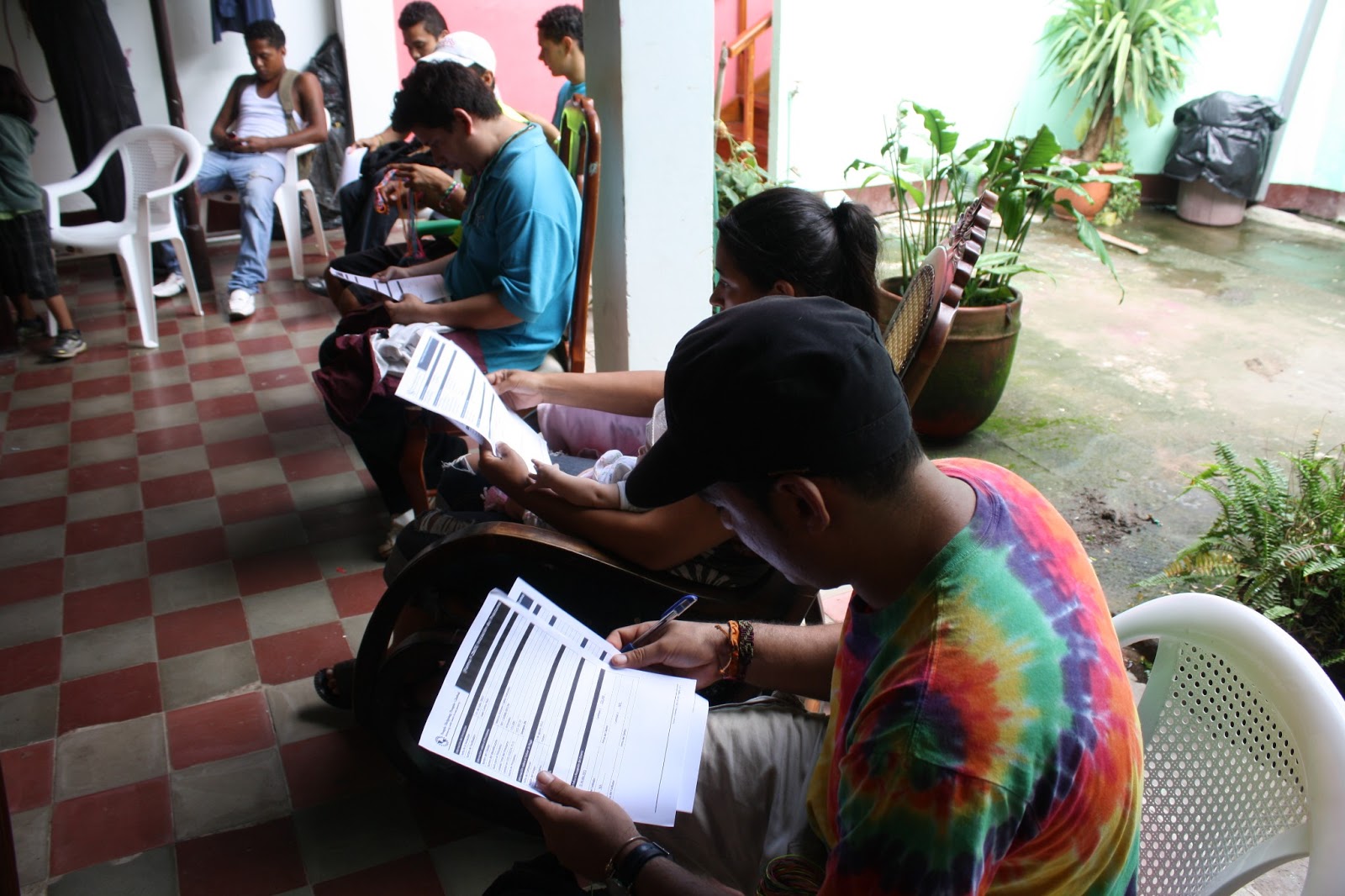
One of the seven group loan applicants
After the interview process, we met as a team to make final decisions on who will be receiving the loans. We have selected five loan groups made up of 22 loan clients with a total value of about $4,000. The loans will be distributed with our standard process; half of the loan will be distributed on the first disbursement date while the second half will be distributed one week later, after the clients show the receipts of the purchases made with the first half of the loan. The PHPG team will start the loan collection process the week following the initial distribution which consists of making rounds by foot in the community to each group leader's house.

Monday, August 12, 2013

Credit as a Human Right

This post is written by PHPG's summer intern, Charlie Bates. Charlie recently finished his sophomore year at Villanova University. Majoring in economics, he is spending the summer in Granada working as a microfinance intern with PHPG and also volunteers at a local elementary school with La Esperanza. 


The PHPG team on a loan collections day in El Pantanal

In the United States, it's common to see ads for websites that offer to calculate credit scores (think freecreditreport.com). The point is obviously to judge whether someone is deserving of the privilege of access to credit. Being a 20-year-old college student, I'm fortunate enough to not know much more than that about credit scores. As I've been working with PHPG, though, I've recently been reflecting the role of credit in light of a very interesting idea by Muhammad Yunus, a pioneer of microfinance. 

Yunus often repeats his deeply embedded belief, “Credit is a fundamental human right.” My first thought: isn't access to credit a privilege given to those who are deserving?

According to Yunus, access to credit is a human right because it allows people to earn themselves the things they're entitled to by virtue of their birth: food, water, shelter, education, etc. It's a human right because, without it, a substantial percentage of the world's population cannot earn enough to afford such basic necessities. 

Most people in El Pantanal, one of the communities in which PHPG works, do not otherwise have access to the credit. For those in the US who use sites like freecreditreport.com to help them get a loan for a car or a luxury item, credit is a privilege; for the folks in El Pantanal who need it to have a chance at creating a better life, it's undeniably a right. But of course, rights come with responsibilities (namely, to repay the loans). And as I explained in my last post, PHPG's clients in El Pantanal understand that responsibility.  


I'm drawing attention to this because, both for us in Nicaragua and for our supporters in the US, it's important to reflect on why we provide access to credit. People Helping People Global doesn't do it because it's a nice thing to do; we do it because we also believe that credit is a fundamental human right.  

Saturday, August 3, 2013

The Pulsera Project Loans in Action

This post is written by Trent Shelton, PHPG's Program Coordinator in the Granada region.

A month ago, we distributed 10 loans to members of the Pulsera Project cooperative. In the past 30 days, each client has had the chance to invest the loan into their own business. Ranging from businesses of buying and selling cheese to repairing and selling cell phones, the young adults are now in action with their own businesses. Here are highlights of a few of the businesses.

Pollera

Yelma, one of the Pulsera Project’s long time coop members, has always wanted to start his own business of raising chickens. However, the high start-up cost was always the main obstacle. Owning a small piece of land on the outskirts of Granada, he was prepared to make his dream come true. With the help of the loan provided by the partnership between the Pulsera Project and PHPG, Yelma has put his business plan into action.

Yelma has constructed a chicken coup equipped with all the necessities. During the day, he makes sure someone is there to take care of the operation, usually himself or a member of his family. To start, 102 chicks were purchased. After raising the chickens to maturity, he will sell them at the local market to earn his profit. Afterwards, more chicks will then be purchased to restart the cycle. Over time, Yelma plans to reinvest his profits to expand the size of his chicken coup in order to raise more chickens and to continually increase his earnings.

Yelma's Chicken Coup

PHPG's Juan Carlos, taking the opportunity to check out the chicken coup

Yelma has purchased 102 chicks which will eventually be sold in the local market


Hamaqueros

Made up of Ernesto, Rommel, Adolfo, and Geovanny, the loan group called the Hamaqueros specialize in the production of hand-made hammocks. Each member was given a loan of about $200, which was used by each of them to invest in their own hammock workshop, tools, and materials. The high-quality hammocks are sold in the Pulsera Project store in Granada. Each hammock takes about 8 hours to make.

Ernesto using his newly purchased hammock workshop

Adolfo preparing his materials

Rommel takes a break from making a hammock to create one of his popular bracelets

Monday, July 15, 2013

PHPG's Partnership with the Pulsera Project

This post is written by Trent Shelton, the new Program Coordinator in Granada. Trent has taken over for Kyle Engelken, who had the position from January until July of this year. PHPG would like to thank Kyle for all of his hard work and dedication to the organization the past six months. Kyle’s passion for microfinance and his desire to help others showed through his high quality of work. Kyle will continue to stay active with PHPG while completing his MBA at William & Mary in Williamsburg, Virginia. 


Trent Shelton - Granada Program Coordinator

It is an exciting time to be part of PHPG! We have many projects in the works and a few more that have recently hit the ground running.

In June, the PHPG team conducted several business training sessions with current clients. Reviewing business concepts like basic accounting and inventory management, the clients left with new accounting notebooks and ideas to implement into their businesses.

Another exciting project is our new partnership with the Pulsera Project. The Pulsera Project’s mission is to educate, empower, and connect Nicaraguan youth with US students. They accomplish this by taking in street kids, teaching them the skills to create bracelets and other artisans, and finally selling the products through their fair-trade business in the US. The project has been hugely successful and the artisans are sold at over 350 schools in the US.

Many of the Pulsera Project’s clients have the desire to start their own businesses, to go off on their own and become entrepreneurs. Combining Pulsera’s successful clients and PHPG’s microloan expertise, a partnership was created.

On June 17th, our team headed over to Pulsera’s beautiful office, located just half a block east of Parque Central. Having already received the loan solicitations and business plans, we met with all 10 potential clients to discuss the microlending program. Juan Carlos, our head loan officer, walked through many examples showing the amount of the loan, the monthly payment, what the entrepreneur would need to earn, etc. The group of borrowers consists of young adults between the ages of 20 and 30, and the businesses rang from making hammocks, to buying and selling cheese, to creating a chicken coup. The entire group was very involved in the discussion and had many great questions. There is no doubt that this discussion made the loan seem more real for the entrepreneurs. The group was excited. They know that this is an incredible chance to create something new; an enormous opportunity but also a huge responsibility.

Pulsera Project clients reading over the terms of their loans.

After conducting interviews with each client, our team evaluated the loans and made decisions on the terms of each loan (total loan amount, repayment period, collection dates, etc.). To continue with our group lending strategy, the clients created three different loan groups named Pulsera 1, Los Colores, and Los Hamaqueros.

On July 1st, we distributed the loans to the excited group. After reviewing the loan terms and having each individual sign the loan contract, Juan Carlos dished out the money. Some, being the joking types, used this as an opportunity to act like they just won in the gameshow “The Price is Right”. All in good humor!

Juan Carlos (left) distributing the loan payment to Carlos Meneses. Carlos has started his business repairing and selling cell phones.

Living just a few blocks away from the Pulsera Project office, I often see the entrepreneurs. Out of curiosity, I asked around just a few days later if they’ve used the money yet to start the business. Within 48 hours, everyone I asked had already purchased tools, inventory, etc. The hammock makers had purchased the tools and materials needed to start producing hammocks. Another gentleman, named Marcos, had already started his business of selling artisans on La Calzada, the main pedestrian street in Granada. He had already purchased a table and a solid selection of inventory to sell to tourists looking for a souvenir from Nicaragua.

I truly look forward to keeping in touch with the clients to see how their businesses are going and to work with them in the process. The exciting partnership between the Pulsera Project and PHPG has now officially hit the ground, and we look forward to working with their incredible organization more in the future.

Thursday, July 11, 2013

Repayment Rates

This post is written by PHPG's summer intern, Charlie Bates. Charlie recently finished his sophomore year at Villanova University. Majoring in economics, he is spending the summer in Granada working as a microfinance intern with PHPG and also volunteers at a local elementary school with La Esperanza. 


PHPG Summer Intern
Charlie Bates - PHPG's Summer Intern

Microfinance has often been termed a miracle. While I don’t seek to address such a bold claim, I would like to draw your attention to a characteristic of microloans that is indeed surprising: their extremely high repayment rates. Unlike traditional banks, most microfinance organizations (at least those that are truly mission-focused) do not require collateral, nor do they have the legal protection from bad debts that traditional banks enjoy. But according to the Grameen Foundation, a pioneering microfinance organization, microloans to impoverished clients have a higher repayment rate than both US student loans and credit card debt.

In PHPG’s case, this translates to a repayment rate well above 90%. How is it possible to give a loan to someone who lacks many resources, except for business skills and a will to succeed, and continue to retain such a high repayment rate?

An easy start is to focus lending efforts on women, who are consistently marginalized in less-developed countries like Nicaragua. The Grameen Foundation points to numerous studies that demonstrate that women are far more likely to invest loans in their businesses and to use the proceeds for their children’s education and health. The fact that 78% of PHPG’s clients are women partially explains our high repayment rate.

Another way that microfinance organizations ensure repayment is by working with clients in “solidarity groups”. Forming groups encourages collaboration and mutual support and provides some healthy peer pressure to repay.

PHPG has seen a tremendous improvement in repayment rates since it started working exclusively in groups. We designate an especially qualified community member as a group leader, and he or she is responsible for collecting the repayments of the other group members and reporting any concerns. Being a group leader is a huge responsibility; if one of the clients does not repay his or her loan, no one in the group is eligible for an additional loan. This sense of responsibility helps increase repayment rates.

Juan Carlos & Juan Carlos Jr. collecting from a group leader


Since microfinance is very relationship-based, a key part of ensuring repayment is to establish and maintain relationships with the clients. More difficult in larger microfinance institutions, this is one of the hallmarks of PHPG’s operations. At our weekly collections, we visit the houses of the individuals and group leaders. Juan Carlos, our professional yet good-humored field manager (he’s an important part of the organization - you’ll be hearing more about him on this blog soon), is the point person for discussing repayment issues with clients. By making an effort to understand their situation and taking whatever steps we can to help, PHPG’s forming of relationships through consistent visits is vital to improving and maintaining our high repayment rate.

On a personal level, repayment comes from the clients’ gratitude for their loan, their dedication to their businesses and families, and their desire to see others in the community succeed using the same funds. It has been interesting to see the effects of PHPG’s measures to ensure repayment, and I look forward to seeing how they develop throughout my time here.


--Charlie