Showing posts with label internship. Show all posts

Thursday, July 11, 2013

Repayment Rates

This post is written by PHPG's summer intern, Charlie Bates. Charlie recently finished his sophomore year at Villanova University. Majoring in economics, he is spending the summer in Granada working as a microfinance intern with PHPG and also volunteers at a local elementary school with La Esperanza. 


PHPG Summer Intern
Charlie Bates - PHPG's Summer Intern

Microfinance has often been termed a miracle. While I don’t seek to address such a bold claim, I would like to draw your attention to a characteristic of microloans that is indeed surprising: their extremely high repayment rates. Unlike traditional banks, most microfinance organizations (at least those that are truly mission-focused) do not require collateral, nor do they have the legal protection from bad debts that traditional banks enjoy. But according to the Grameen Foundation, a pioneering microfinance organization, microloans to impoverished clients have a higher repayment rate than both US student loans and credit card debt.

In PHPG’s case, this translates to a repayment rate well above 90%. How is it possible to give a loan to someone who lacks many resources, except for business skills and a will to succeed, and continue to retain such a high repayment rate?

An easy start is to focus lending efforts on women, who are consistently marginalized in less-developed countries like Nicaragua. The Grameen Foundation points to numerous studies that demonstrate that women are far more likely to invest loans in their businesses and to use the proceeds for their children’s education and health. The fact that 78% of PHPG’s clients are women partially explains our high repayment rate.

Another way that microfinance organizations ensure repayment is by working with clients in “solidarity groups”. Forming groups encourages collaboration and mutual support and provides some healthy peer pressure to repay.

PHPG has seen a tremendous improvement in repayment rates since it started working exclusively in groups. We designate an especially qualified community member as a group leader, and he or she is responsible for collecting the repayments of the other group members and reporting any concerns. Being a group leader is a huge responsibility; if one of the clients does not repay his or her loan, no one in the group is eligible for an additional loan. This sense of responsibility helps increase repayment rates.

Juan Carlos & Juan Carlos Jr. collecting from a group leader


Since microfinance is very relationship-based, a key part of ensuring repayment is to establish and maintain relationships with the clients. More difficult in larger microfinance institutions, this is one of the hallmarks of PHPG’s operations. At our weekly collections, we visit the houses of the individuals and group leaders. Juan Carlos, our professional yet good-humored field manager (he’s an important part of the organization - you’ll be hearing more about him on this blog soon), is the point person for discussing repayment issues with clients. By making an effort to understand their situation and taking whatever steps we can to help, PHPG’s forming of relationships through consistent visits is vital to improving and maintaining our high repayment rate.

On a personal level, repayment comes from the clients’ gratitude for their loan, their dedication to their businesses and families, and their desire to see others in the community succeed using the same funds. It has been interesting to see the effects of PHPG’s measures to ensure repayment, and I look forward to seeing how they develop throughout my time here.


--Charlie

Monday, May 6, 2013

Sum of my experience with PHPG in Granada by Lana Balyk

It is hard to believe that I already find myself back in Canada, since it seems like just last month I wrote my last blog entry while preparing to depart for Nicaragua. Five months have passed since then, during which time PHPG has continued to move forward with strengthening its micro-loan programs, and also has seen the arrival of new and talented interns and employees.

The first part of my time in Granada was mainly spent getting to know the program, which was transitioning in a new direction with new ideas and new staff, as well as getting to know the city of Granada itself. The Granada based employees are great staff, and PHPG lucked out finding such great workers who really believe in their organization. If I did not already have an idea about the difficulty of getting set up in a new city and getting work underway during a holiday period in Nicaragua (most of the month of December), I would have learned that very quickly! However that is a very special time to experience Granada, which still holds to the tradition of everyone lighting off their own fireworks intermittently throughout the month, and of course all together at once for hours on Christmas and New Years in a midnight symphony of exciting and slightly dangerous mayhem! I always enjoy a warm Christmas, and the temperature is great in Granada at this time of year.

Juan Carlos, Lana, & Kyle conducting a PHPG informational meeting
Into the New Year another intern arrived, Kyle, and we set out gathering information and making observations about PHPG’s clients and current loan program, as well as planning and delivering a workshop to educate clients on our loan procedures, and prepare them for when Alex and Isabel would arrive in February to organize more loans. During this time the heat continued to climb, and working outdoors in our communities gave me a new appreciation of how people are able to spend all day working outdoors in tropical countries. If Canada had that kind of heat, I think the ongoing highway construction and maintenance that goes on every summer would come to a halt!

Once Alex and Isabel arrived then all of us coordinated, shared ideas, made adjustments and moved forward with preparing PHPG’s clients for the next installments of loans. It was especially great to see our Granada employees have a strong role with the planning as well, as I really feel that they know their communities and their cultural contexts best. The interviews were one of the most interesting parts of my time in Granada, and it was so interesting to see the different businesses our clients have, and what they wanted to do with them. Some of the clients we normally visit are ambulatory vendors who do not necessarily sell their wares or products from their home or have them on hand to view, so the interviews were a great chance to see some different businesses in action, such as people producing leather shoes from scratch, or creating silver jewelry. Once the first loans were dispersed, it was interesting to see what clients used them for, how they modified their businesses, or how one even built a clothing shop in front of her home to display her wares. Unfortunately I returned to Canada before the next round of loans was handed out, so I was unable to take part in that work, but I am glad to hear that it went just as well.

The PHPG team reviewing & signing disbursement documentation
I am very glad that I was still in Nicaragua to be part of the interview and initial loan disbursement process, since that was one of the highlights of my job in Granada. The communities that PHPG work with are very lacking in resources, including regular electricity or in-home running water. However most of the clients I spoke with seem happy with their lives, and feel positive about their children’s prospects. It was really great to see how some people worked really hard to grow their businesses, and how proud they are of their efforts.

My experience in Nicaragua with PHPG was very valuable to me in that it allowed me to learn more about micro-finance in general, as well as gain practical experience about the workings of a small micro-finance NGO. In addition I was able to meet some wonderful people, gain some different perspectives and contribute to an organization that continues to grow and develop.

Monday, April 22, 2013

New loans, improved businesses, and more help in Nicaragua


Kyle and the PHPG team just finished distributing to six new loan groups in Granada (28 individuals in total) for a total of 117,000 Cordobas or around $5,000. The average loan was roughly $175. For folks living on close to $2 per day, these loans are quite significant. As we’ve mentioned in previous posts, PHPG assists these families by providing them enough working capital to increase confidence and financial transparency to a point where that they can focus on medium to long term goals of taking their business to the next level. It was great to see a handful of repeat borrowers this time around. The individuals that successfully completed a prior loan with PHPG have access to more credit and enjoy a faster turnaround time to receiving their loan.

One repeat borrower stood out. Her name is Gema Lisseth and she received her second loan with PHPG for 5,000 Cordobas. When the PHPG team arrived at her house to check on her inventory purchases before distributing the second half of the loan (she sells new and used clothing), we were blown away by her brand new store-front constructed in front of her home. She mentioned in her interview that she wanted to create a little “tiendita” but we weren’t expecting such a quick turnaround. Gema had been selling clothing from a cart that she takes around the neighborhood, but with another loan and more confidence she decided to sell some out of her home too. We could tell how proud she was to show us her new shelves and clothing rack.  Kyle looks forward to stopping by her house each Friday for payment collection.

Gema Liseth & Isela in front of their new storefront
Next week PHPG will be distributing a new round of loans to repeat borrowers on Las Isletas in Lake Nicaragua. A total of 112,000 Cordobas will be distributed across 26 individuals that qualified. The majority of borrowers in Las Isletas are Pescadores (fishermen) requesting loans to fix their boats, purchase new nets, and buy salt for preservation. Many of the fishermen aspire to save enough money to buy their own boat in the future. For now, most loan participants rent their boats and pay the owner in fish after the day’s catch.

PHPG team disbursing new loans
Kyle is keeping busy with all of this, but luckily he will have a few new volunteers joining him over the next month. A few university students are coming down in May for summer internship positions and Kyle is excited to put them to work. There are a lot more improvements to be made and it will be nice to have a fresh set of eager eyes on the project.

Wednesday, June 13, 2012

Empowering Women with PHPG in Piedras Coloradas


Hey Y'all!

The "Red Rocks" at Piedras 
Coloradas
My name is Morgan Tucker and I am a Microlending Intern with PHPG this summer in Nicaragua.  I wanted to update all of the donors, regular readers and anyone checking out this blog about PHPG's work in the department of Matagalpa in Nicaragua.  As many of you know, PHPG began working in the department of Granada and does most of their work there.  However, last fall they expanded to the northern, more mountainous department of Matagalpa to a community called Piedras Coloradas ("Red Rocks").  I was fortunate, as there was only one spot for an intern to go, to be able to visit Piedras Coloradas about three weeks ago for PHPG's monthly meeting.

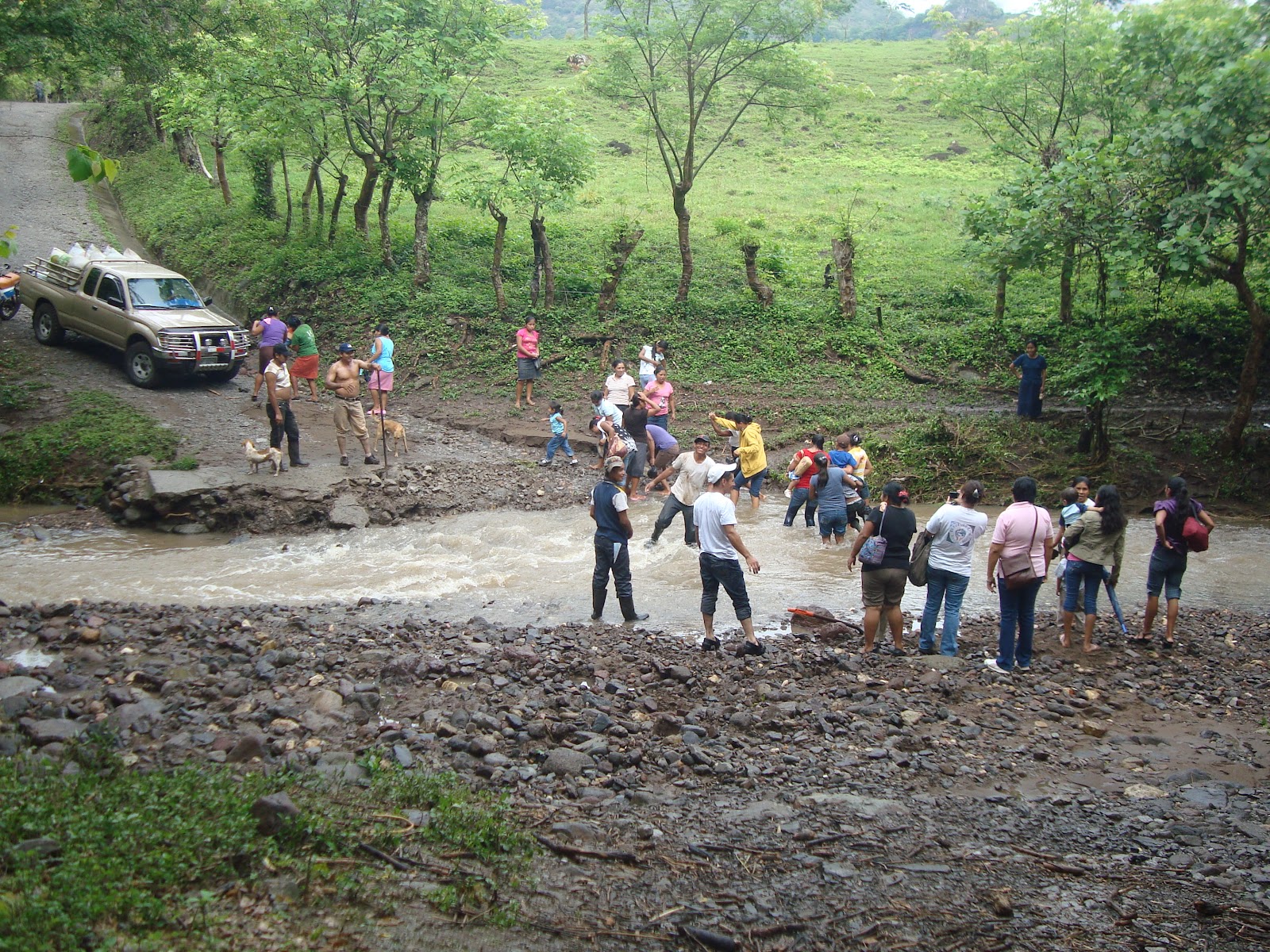
All of these women were in the back
of our truck and had to get out  and
cross the river  on foot so our truck
could make it across.  The male
workers were filling in the river with
enough rocks to make it passable.
Piedras Coloradas is named "Red Rocks" because of the large rocks on the side of the nearby mountain that turn red in the sunlight.  It is a very poor, isolated community.  PHPG lends to people that live on less than $2 a day, but the borrowers in Piedras Coloradas actually live on less then $1 a day.  There is no cell phone service of any kind and it is very difficult to get to.  It lies down a dirt road full of rocks which includes crossing two or three streams without bridges.  A bus only arrives and departs twice a day and you can forget about taxis. PHPG workers go in a truck with another development organization, ADIC ("Association for Integral Community Development"), that also works in the community monthly.  ADIC mainly works with community health through education and other projects.  For example, they built latrines in Piedras Coloradas where there were none before and where virtually no one has any type of bathroom in their home.

A group working on their poster
Women from Piedras Coloradas and another community, Samulali, met with both of our organizations in a school house.  First, ADIC did a workshop entitled "Identity and Conditions of Women" as part of a campaign for the International Day of Women's Health and Mother's Day.  The workshop was led by two ADIC workers: Silda and Rosalia.  The objective of the workshop was to promote a process of reflection among women by leading them through expressing what happens to them, what they live through, and what they want in order to bring about changes and transformations in themselves.  Another objective was to promote confidence and community among the women from both communities and women of different ages.  After an icebreaker, the women were put into groups and given a list of questions that addressed the objectives.  Then they all made posters answering these questions and presented them to everyone in the workshop.

A full room for ADIC's workshop
I learned quite a bit about the status of women in Nicaragua by listening to what these women had to say throughout the workshop and combining it with my observations of the country.  Women in Nicaragua face the same challenges as women everywhere else in the world.  Issues that are particularly salient in Nicaragua include the high rates of sexual violence, incest between older men and girls, men abandoning their spouses and children, domestic violence, and young pregnancy.  Although there are many of the same legal protections on paper for women here as in developed countries, women generally have nowhere to turn when they find themselves in any of the above situations.  The few police forces that exist are not very mobile (as in they don't really have vehicles) and will usually tell those involved in disputes to work it out themselves.  Many cases that go before courts are usually not ruled in the favor of women's rights.  Furthermore, because many women do not have enough income to be independent of their spouse and do not have other resources, such as shelters, they have no way to improve their condition.  Many women in the workshop admitted to facing domestic violence and needing their husband's permission to even come to the workshop.  Additionally, many women admitted to not being able to read despite the government's assertion that there is no illiteracy in this country.

Other aspects of women's health were an important subject of the workshop.  Rosalia stressed the importance of sexually active women getting paps once a year and the places where it could be done affordably.  She mentioned that there are many lies out their that deter women from getting paps, such as that it will sterilize you.  The workshop also address women's role as mothers in the health of their family.  It is common in Nicaragua for children to be fed a lot of soda because the children think it tastes good and all of the sugar fills their empty stomachs.  Rosalia pointed out that women need to take more advantage of all of the natural fruits and vegetables around them in the forest as a source of food and drink.  

PHPG's meeting

After the workshop, those who have loans with PHPG remained for our meeting.  There are currently 23 borrowers, which are only from Piedras Coloradas, and 16 of them make biannual payments while 7 make monthly ones (they had the choice between the two payment cycles).  All of the loans are individual, versus in group, and all of the current borrowers are on their first loan with PHPG.  We were there to collect the monthly payments and to talk with the borrowers about any difficulties they were having.  We were also there to continue the process of disbursing 50 loans to new borrowers.   That day we were reviewing loan requests with the borrowers and having them sign them.  PHPG is planning on disbursing these new loans in August.

Loan Officer, Gilbert, reviewing a loan 
request with a new borrower, Marcia,
 before she signs it
Before I came to Piedras Coloradas and heard about this system, I wondered, how can this be microfinance?  One of the principals of microfinance is that borrowers make small, frequent payments, which puts less pressure on them, and has produced higher repayment rates than commercial banks.  Then I found out that every single borrower in this community works in agriculture, mostly coffee.  Because Nicaragua has a warm climate all year round, crops can be grown all year round.  Nicaragua also has two seasons that are 6 months long each: winter which is the rainy season (May - October) and summer which is the dry season (November - April).  These seasons coincide with growing seasons: the "normal" season during winter and la postera (post as in after the normal season) where "extra" things are grown.  Because of this, borrowers make all of their profits twice a year, after each season, and it is thus more practical for them to make their loan payments twice a year.  I was impressed on how PHPG had adapted their process to local conditions.

Every single borrow in Piedras Coloradas is a woman.  This is not because it is PHPG policy, but because women tend to seek microloans to invest in their businesses.  First of all, Nicaraguan women have a special entrepreneurial spirit that can be seen from all of the women working in the informal sector in the street and open air markets.  Secondly, the spouses of women in Nicaragua are often employed in other businesses while women work in the home.  Therefore, women often start their own businesses, usually out of the home, in order to bring in more income to improve their families' lives.  It is more feasible for women to work out of their homes because, again, they have other responsibilities with managing the home and children and they don't have to invest in a different location for their business.  Because women are in charge of managing scarce resources for the family, they are also more likely to invest a loan wisely in their business.  As Gilbert said to me the other day, "If you send a women to the market with $5, she will come back with lunch for everyone.  If you send me, I won't come back with anything."  Giving women the opportunity to earn income for their work gives them more power and independence in getting out of the many situations harmful to women's health mentioned earlier.

Me riding in the back of the truck after 
a great day in Piedras Coloradas
I learned a few things about the practice of development that day.  First, I learned how important it is for development organizations to work together in order to be successful.  When development organizations work together they can pool resources, and avoid duplicative services, which makes them more effective.  The workshop seemed successful because of its quality, especially the quality of leadership of Silda and Rosalia, and high attendance.  I think there was such high attendance because they made it possible for the women to get there.  ADIC picked up everyone in the back of their truck that lived too far to walk, and not only allowed them to bring their children, but acknowledged that it was their right as mothers.  Without transportation, and the ability to care for their children, these women would not have been able to come to ADIC's or PHPG's meeting.  ADIC also fed everyone lunch which encouraged people to come and socialize in a more informal setting.

In addition, because ADIC and PHPG have a regular presence in the community they have effects that would not otherwise be realized.  ADIC was already announcing that they would be back in a month to have a workshop on baking breads and desserts, and of course, PHPG will be going back with them for our monthly meeting.  Some women were very confident in speaking in front of a large group while others would not even speak when called upon.  Building women's confidence in themselves is an important psychological aspect of empowering women and can happen in this group overtime, because our organizations visit regularly, as the women become more comfortable with each other.

I also learned that it takes people of all different backgrounds to make development work.  Here you had  ADIC which was an organization funded by a variety of foreign (mostly European) and domestic sources and administrated by Nicaraguans, and PHPG, which is an American organization that also has Nicaraguan employees.  Some people would call this Nicaraguan dependence on unsustainable foreign aid while I see it more as world citizenship.  However, the most important factor was that the people in the community were actually participating.

Thank you to all of the donors who have made this kind of change possible and all of those who are interested in PHPG.  I encourage you to follow this blog as well as mine and the other summer interns listed on the right side of this page for more news about PHPG.  

Peace!
Morgan 

Monday, March 26, 2012

New Summer Intern


Greetings from Austin, Texas!

My name is Becca Moore. I will be interning with PHPG this summer (from mid-may to early August) in Granada. Less than 2 months until I'm in Nicaragua!

I am in my second year of graduate school at the LBJ School of Public Affairs at the University of Texas at Austin. I will be graduating with a masters in Global Policy Studies with a concentration in International Development in December. I'm really excited to get out of the classroom and put my education to the test.

As an undergraduate, I studied environmental engineering at Rensselaer Polytechnic Institute in Troy, New York. My junior year, I studied abroad in Monterrey, Mexico. While I was there, I traveled extensively throughout Mexico- I actually traveled more in Mexico than I have in the U.S. (I hope my Spanish returns quickly!)

After graduating, I was itching to travel again, so I went to Thailand to teach English. I absolutely loved Thailand. I taught English at a high school in Lampang (a city in the north). I taught about 24 classes a week and had over 800 students! It was a bit overwhelming, but an amazing experience. While I was in Asia, I was able to visit China, Laos, Cambodia, and Nepal.

In Nepal, I volunteered for a month at an NGO called Environment and Public Health Organization, working on designing decentralized wastewater treatment plants on the Bagmati River in Kathmandu. It was there that I knew that I wanted to work in the International Development field. Volunteering in Nepal led me to grad school in Austin and eventually this internship with PHPG. I'm really excited to be working with PHPG this summer!

Wednesday, March 21, 2012

A New Intern Joins the Team


Hello PHPG enthusiasts!

As one of People Helping People Global’s newest interns, I will be living in Nicaragua from mid-May through August 2012. And I couldn’t be more excited! The more I learn about PHPG, the more I feel as though my values align with those of the organization, and the more passionate I become about helping this amazing cause.

As an undergraduate student at Skidmore College, I am dedicated to the study of Anthropology and Latin American Studies, both in the classroom and in my extracurricular activities. While building an academic foundation in fields that will aid me in my pursuit of international community development, I have found external outlets to apply all that I have learned from my professors, and to gain field experience. In an effort to improve the lives of my neighbors, I am currently administering needs-assessment surveys to the residents of local mobile home communities so that the Saratoga County Economic Opportunity Council can improve and broaden their services. I am also volunteering at a medium security correctional facility as a workshop leader to open up dialogue among inmates on issues such as employment, stress management, conflict resolution, and family reintegration. These opportunities have awarded me the chance to work with unrepresented and undervalued populations living right next door, and soon (although not soon enough), I’ll learn how to do the same in Nicaragua.

While my micro-lending internship with PHPG in Nicaragua will be a new and exciting experience, I am no stranger to the non-profit sector. From my collaboration with many different NGOs while living in Mexico, Peru, Ghana, and the United States, I have learned a good bit about how different organizations function. And People Helping People Global already strikes me as one of the most organized, well-intentioned, and efficient NGOs that I have encountered thus far. Their dedication to promoting sustainability, empowerment, and cultural pride is refreshing and inspiring. I can’t wait to meet everyone and to be a part of this incredible mission.

Thank you for this wonderful opportunity, and I look forward to helping others to make a difference in their lives through People Helping People Global.

Take care,
Phoebe